


A construction-to-permanent loan with a one-time close covers the cost of building your home and rolls it into a permanent mortgage in a single closing, with a minimum credit score usually starting around 680 and a down payment typically running 10% to 25% of total project cost.

You lock your permanent rate before the first shovel hits the ground, and the loan converts automatically once the home is finished, no second application, no second round of closing costs.
That single-closing structure is what separates it from a standalone construction loan, which forces a second closing once the house is done. Most conforming lenders, including us, offer this within the conventional loan program, which means it stays inside the 2026 baseline conforming loan limit for a primary residence purchase, or a second home if that’s what you’re building.
How the one-time close structure actually works
During construction, the loan behaves like a short-term line of credit. The lender releases funds to your builder in stages tied to a draw schedule, foundation, framing, mechanicals, finish-out, rather than handing over the full amount up front. You pay interest only on the portion drawn so far, not the full loan balance.
The draw schedule is usually established before construction starts. As the builder completes specific milestones, an inspection or other verification confirms the work, and the lender releases the corresponding funds. This gives the lender control over how the construction proceeds and helps make sure the loan proceeds are being used for the project outlined in the approved budget.
For example, if you initially receive only $100,000 of the loan, your interest payment will typically be based on the amount you actually received, not the entire $400,000 commitment. The more you receive on the loan, the more interest you will accrue.
After the home has successfully passed the final inspection and a Certificate of Occupancy has been issued, the construction loan will be converted to a permanent financing. The construction period is typically a maximum of 12 months, and may be extended to a total of 18 months. After the loan is converted, the repayment period of the permanent financing can be up to 30 years; the construction period does not count toward the 30 years. At this point, your payments will also switch from “interest-only” to regular principal and interest payments, at the same interest rate you locked in when you closed.
What it takes to qualify, in brief
Credit and down payment requirements run higher than a standard purchase mortgage because the lender is underwriting two risks at once, the build and the long-term loan. As a starting point, most conventional programs want a 680 credit score or better, with the strongest pricing showing up above 740, and 10% to 25% down depending on the lender and your file. If you already own your lot outright, that equity typically counts toward your down payment.
Debt-to-income limits, reserve requirements, and the full underwriting checklist go deeper than that, so if you want the complete breakdown before you talk to a loan officer, our construction loan requirements guide covers it in detail.
Your income and employment history still matter just as they would with a conventional mortgage. The lender needs to determine that you have enough qualifying income to support the permanent mortgage once construction is complete. Self-employed borrowers may need additional income documentation, including business records and tax returns, depending on how their income is calculated.
One-time close vs. two-closing construction loans
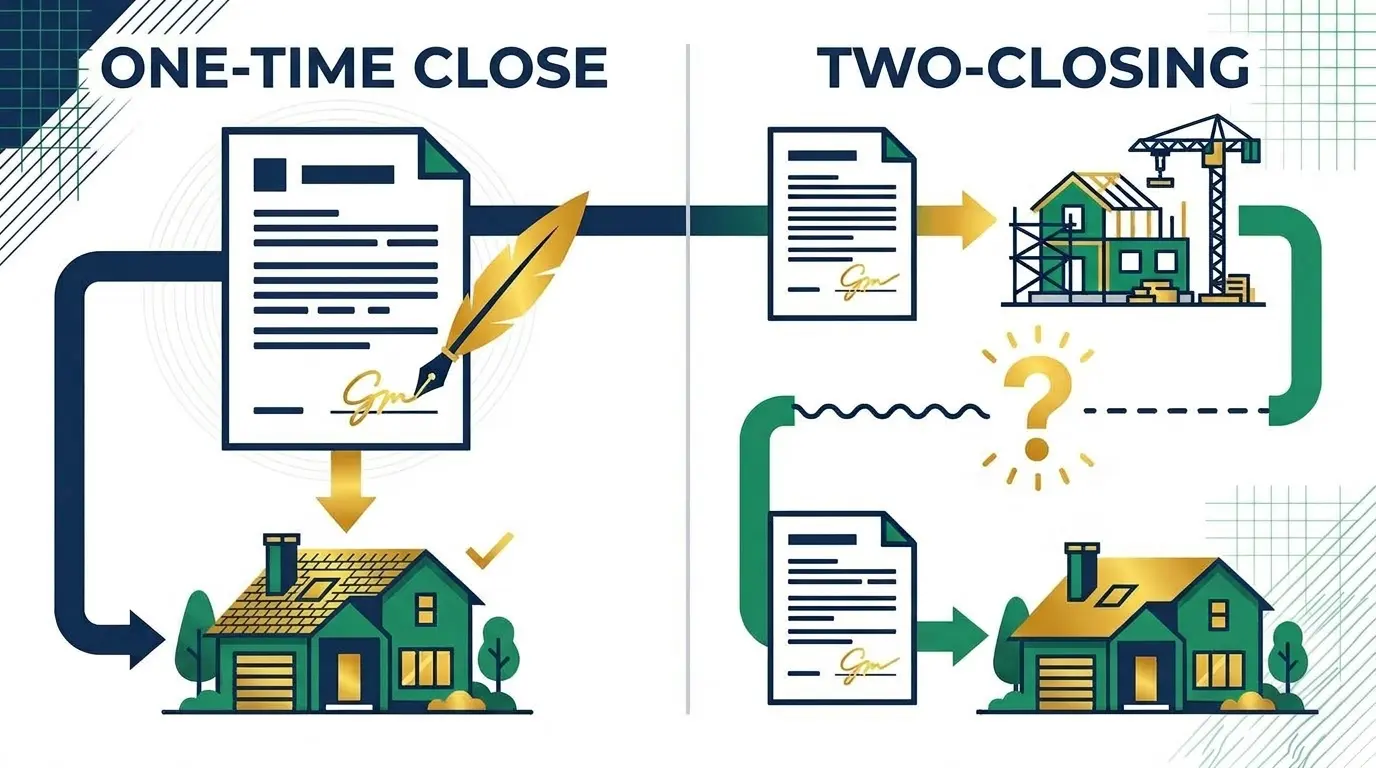
The easiest way to understand the difference between the two is to look at when a permanent mortgage is established.
In a One-Time Close Construction-to-Permanent Loan, you close the loan once, before construction begins. The construction financing and permanent mortgage are both arranged as a single transaction. Once the home is finished and all of the lender’s requirements are met, the loan enters the permanent repayment phase.
In a Two-Closing, however, you first close a separate contract for the construction loan. Once the home is completed, you apply for a separate permanent mortgage and close that loan independently. This second transaction may involve a new loan application, underwriting, appraisal, title work, and closing costs.
A two-stage structure can provide more flexibility in some circumstances, but it also exposes the borrower to more uncertainty about the terms of the permanent financing in the future. Over the course of a long construction project, interest rates, the borrower’s credit standing, income, property values, and lender requirements may change.
A one-time close eliminates much of this uncertainty because the permanent loan is determined and established from the outset. In contrast, you must meet all of the lender’s terms and conditions before construction begins and proceed with the project according to the specifications and framework that were approved from the start.
The builder has to qualify too, not just you
The builder has to be licensed, insured, and approved by the lender before you close, and the lender reviews the builder’s track record and financial standing alongside your own file. Owner-builder and self-build arrangements generally aren’t permitted under standard one-time close programs, so if you were planning to act as your own general contractor, confirm that with your loan officer before you’ve spent time on plans.
Detailed construction plans, a signed builder contract, and a cost breakdown all go into the file, and the appraisal is based on the home as it will exist once built, using your plans and specifications, not the raw land value.
What the numbers look like on an actual project
Take a self-employed buyer building a 2,200-square-foot primary residence on land she already owns outright. Her construction budget is $420,000. With a 720 credit score and 15% down on the construction costs, she’s putting roughly $63,000 down, with her paid-off lot covering part of the equity cushion lenders like to see.
Her construction period runs 10 months. She makes interest-only payments on each draw as it’s released, then converts to a fixed-rate permanent mortgage the month after final inspection, at the rate she locked when she closed.
The important detail is that her monthly construction payment isn’t necessarily calculated as though she had borrowed the entire $420,000 on day one. If the lender has only released a portion of the funds, the interest-only payment is based on the outstanding construction balance. As the project progresses and additional money is drawn, the payment increases.
The loan rolls over and the payment structure changes. Instead of paying interest only on the outstanding construction balance, she begins making regular principal-and-interest payments on the permanent mortgage.
You can also play with your own numbers, of course. A construction-to-permanent loan calculator essentially models three things: your estimated interest-only payments during the draw period; your converted principal-and-interest payment when the home is finished; and how much of your down payment your lot equity offsets. A loan officer can run this for your specific project faster than any generic calculator because the draw schedule and construction timeline are unique to your builder’s contract.
This example is illustrative only. Your actual rate, APR, down payment, and repayment terms depend on your credit profile, the lender, and market conditions at closing, so treat it as a starting point for the conversation, not a quote. For where permanent rates stand right now, our current construction loan rates page tracks that week to week.
How the lot affects your financing
If you already own the land where you’re building, the lot can play an important role in the transaction. Its current value and your existing equity may count toward the required investment in the project, depending on the lender’s guidelines and how the transaction is structured.
For example, someone who purchased a lot several years ago and has no remaining mortgage on it may have substantial equity before construction even begins. That equity can reduce the amount of new cash the borrower needs to contribute, although the lender still determines how the lot value is treated for underwriting and loan-to-value purposes.
Costs to consider beyond the down payment
The down payment is only one part of the cash you may need for a construction-to-permanent loan. Borrowers should also account for closing costs, appraisal fees, title expenses, inspections, permits, prepaid taxes and insurance, and other transaction-related expenses.
Construction projects can also have unexpected costs. Material prices can change, site conditions can create additional work, and homeowners sometimes decide to make upgrades after construction has started. A lender-approved construction budget is not the same thing as an unlimited pool of money for changes.
For that reason, maintaining adequate cash reserves can be particularly important. You don’t want to use every dollar available for the down payment and then have no liquidity if the project encounters an expense that isn’t covered by the approved loan.
Another consideration is the construction timeline. If the project takes longer than expected, an extension may be required. Depending on the lender and loan terms, an extension can involve additional fees or other requirements.
What happens before you close
A construction-to-permanent loan is a little more work than a regular home purchase. Before closing, the lender usually requires the construction plans and specifications, builder information, contract, project budget, land information and appraisal.
This appraisal is particularly important because the lender isn’t only concerned with what the land is worth at present. The appraiser examines the plans and specifications to determine the expected value of the property when construction is finished.
The lender then compares the proposed loan amount and project costs to the expected completed value and applies its underwriting guidelines. If the numbers don’t support the financing requested, the borrower might need to change the project, increase the cash contribution, or consider an alternate loan structure.
