


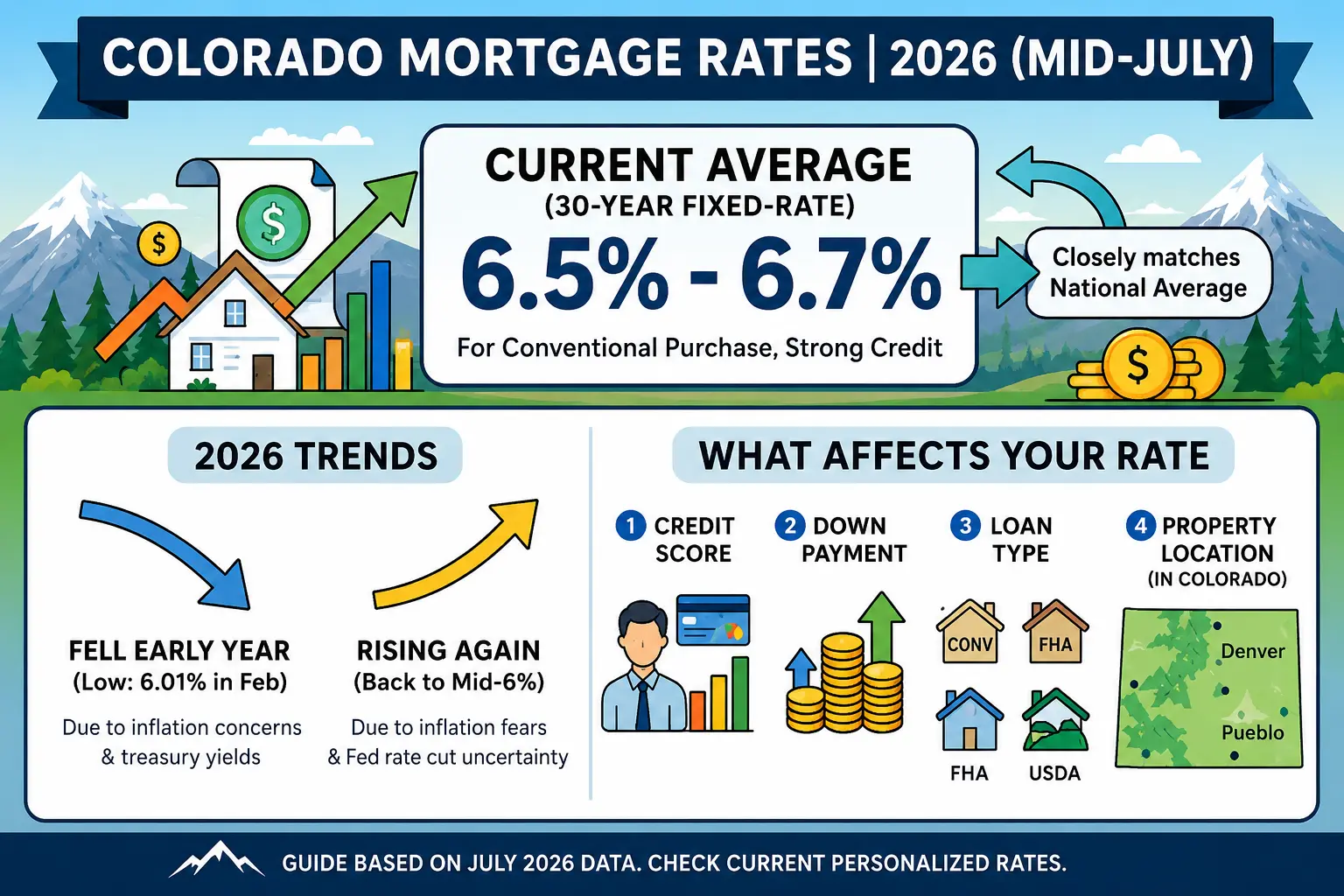
The average 30-year fixed-rate mortgage rate in Colorado is currently very close to the national average. As of mid-July 2026, the rate for a conventional purchase loan with strong credit is in the 6.5% to 6.7% range.
What are Colorado mortgage rates right now?
The current national average for a 30-year mortgage is 6.626%, and Bankrate reports the average 30-year fixed rate as of July 15, 2026, at 6.59%.
Freddie Mac’s weekly survey, which typically shows lower rates because it calculates Conforming Loans with 20% down payments and applicants with strong credit, reported a 30-year fixed-rate mortgage rate of 6.49% for the week ending July 9, 2026.
Borrowers in Colorado typically receive rates within a few basis points of these national figures because the state alone has neither rate hikes nor rate discounts. What really determines your rate is:
- Credit Score
- Down Payment Amount
- Loan Type
- Location of the property within the state of Colorado (for example, a condo in Denver will be priced differently than a USDA-qualified property near Pueblo.)
To better understand the current trend, rates fell for most of the first two months of 2026, hitting a 2026 low of 6.01% on February 19th; this was the lowest weekly average since September 2022. After that, rates have since returned to the mid-6% range (based on Bankrate’s historical rates).
The Mortgage Bankers Association also reported that the average 30-year mortgage rate rose to 6.65% in the week ending July 10th, 2026; Because U.S. Treasury yields have been rising on inflation concerns and market expectations that the Federal Reserve may raise interest rates by the end of the year, not cut them.
If you’re following daily rate changes, the best free, public reference is Freddie Mac’s Primary Mortgage Market Survey, which is updated every Thursday.
If you’re looking for a live rate that’s tailored to your situation, it’s best to visit our own mortgage rates page and not rely solely on national averages, as your actual rate will depend on your credit report.
Why do Colorado rates move in line with (or against) national trends?
Mortgage rates in Colorado are largely determined by the bond market, specifically the yield on the 10-year U.S. Treasury note, rather than directly by the Federal Reserve’s decisions on short-term interest rates.
Rising borrowing costs have reduced demand for mortgages; Total mortgage applications have fallen for two straight weeks, with purchase applications falling more than refinance applications.
Two factors specific to Colorado are more important than the Fed news:
-
Limited inventory versus demand
Although the market has calmed down since the height of the pandemic, active inventory statewide stands at 30,803 listings, equivalent to about 4.3 months of supply, and the median sale price remains near $550,000.
That’s still below the five to six months of supply typically considered a balanced market, so there’s some upward pressure on home prices even as interest rates rise.
-
Huge Price Differences Between Counties
The median home price in Colorado as a whole is expected to reach $600,000 by May 2026, while in tourist counties like Pitkin, San Miguel, and Summit, the median price of single-family homes will reach several million dollars.
As a result, a buyer buying a home in Pueblo or Grand Junction faces a very different loan amount and therefore sensitivity to interest rate changes than a buyer looking to buy a home in Aspen.
Types of Mortgages in Colorado
Each type of mortgage, whether for home purchase or investment, has its own unique features and benefits. Below, we compare the main options for buyers in Colorado.
Conventional Loans
Conventional loans are not insured by any government agency. They are typically backed by private lenders or the Federal National Mortgage Association (Fannie Mae) and Freddie Mac.
- Credit Score: Typically requires a stronger credit history than government-backed loans.
- Down Payment: Can start as low as 3%, although a higher down payment usually results in a better rate.
- Mortgage Insurance: If the down payment is less than 20%, private mortgage insurance (PMI) is applied and is waived once 20% equity is reached; Unlike FHA insurance, which may last for the life of the loan.
- Best for: Borrowers with good credit who want an easier path to a loan and plan to eliminate PMI in the future.
FHA Loans
FHA loans, insured by the Federal Housing Administration, are designed for buyers who may not qualify for a conventional loan, making them a popular option for first-time homebuyers in Colorado.
- Credit Flexibility: Accepts lower credit scores than most conventional loan programs.
- Down Payment: Starts at 3.5%.
- Mortgage Insurance: Includes both an upfront premium and an annual premium, regardless of the down payment amount.
VA Loans
Guaranteed by the Department of Veterans Affairs, VA loans are one of the most valuable benefits for eligible veterans, active duty military personnel, and surviving spouses.
- In most cases, they require no down payment.
- They do not require PMI insurance, so your monthly payment will be significantly lower than a conventional loan at the same rate.
- They offer more flexibility in credit scores and debt-to-income ratios than conventional loans.
USDA Loans
Backed by the U.S. Department of Agriculture, these loans are designed for eligible properties in rural and some suburban areas of Colorado, such as areas outside the Front Range corridor.
- No down payment
- Income restrictions apply based on the area’s median income.
- There is a geographic restriction; the property must be located within a USDA-approved area.
Adjustable-Rate Mortgages (ARMs)
ARMs have a fixed interest rate for a set period of time and then adjust based on market conditions.
These loans typically have a lower initial rate than a 30-year fixed-rate mortgage, so they’re worth considering if you don’t plan to stay in your home for a long time.
Jumbo Loans
Jumbo loans are used for properties that exceed the FHFA’s Conforming Loan Limit, which is $832,750 for most areas of the U.S. in 2026.
Given the high prices of homes in Colorado’s tourist markets, jumbo loans are very common outside of the Denver market.
In exchange for financing a higher-value property, you should expect stricter credit score, debt-to-income ratio, and a larger down payment.
Case Study, A First-Time Homebuyer Teacher Used Colorado’s Down Payment Assistance
Here’s a real-life example of how the numbers work for a first-generation or first-time homebuyer using government assistance, exactly the type of scenario that CHFA programs are designed for.
Let’s say a public school teacher in the Denver metropolitan area is looking to buy a $400,000 home using a CHFA FirstStep mortgage.
The Colorado Housing and Finance Authority (CHFA) offers two types of assistance, and the buyer chooses one:
- A down payment assistance of up to the lesser of $25,000 or 3% of the first mortgage amount. For example, if the loan amount is $200,000, the grant would be approximately $6,000 and would never need to be repaid.
- A second loan with deferred repayment of up to 4% of the first mortgage amount at a zero-interest rate that would be repaid when the property is sold, refinanced, or the first loan is paid off in full.
If we calculate this example for a first loan of $400,000, the grant amount would be approximately $12,000; an amount that could cover most or all of the 3% down payment on an FHA loan, plus a portion of closing costs.
To be eligible, the teacher must:
- Have a minimum median credit score of 620.
- Complete a CHFA-approved homebuyer course.
- Income and purchase price of the home do not exceed the applicable county limits. (These limits vary by county; in El Paso County, for example, the 2026 income cap for single- or two-person households is $127,800.)
Combining this grant with a 2 to 3 percent seller’s down payment, common in Colorado’s current buyer-oriented market, a teacher who would normally have to pay between $20,000 and $30,000 at closing might be able to buy a home with only about $1,000 to $3,000 of their own money.
How to Increase Your Chances of Getting a Mortgage in Colorado
Improve Your Credit Score
Your credit score has a direct impact on both your chances of getting approved for a loan and the interest rate you receive.
Check your credit reports, dispute and correct any errors, make all payments on time, and reduce your revolving balances before applying for a loan. Even a 20-point increase in your credit score can get you into a better pricing bracket.
Save for a Higher Down Payment
A higher down payment lowers your loan-to-value ratio (LTV), which can lead to a better interest rate, and with conventional loans, you no longer need to pay private mortgage insurance (PMI) once you reach 20% equity.
If saving that much is difficult for you, that’s exactly why CHFA down payment assistance programs are designed to bridge the gap.
Keep your employment and income stable
Lenders typically require two years of stable income history and documentation such as:
- Pay stubs
- W-2 forms
- Tax returns
Changing jobs within the same field usually isn’t a big deal, but a gap in your employment history can often be a problem.
Lower your Debt-to-Income Ratio
Most lenders prefer that your total monthly debt, including your new mortgage payment, be less than 43 to 45 percent of your gross monthly income for conventional loans. (With VA and FHA loans, this limit can be more flexible.)
Pay off high-interest debt first, and avoid taking on new debt, such as a car or home appliances, until you’re ready to close on your home.
Research your mortgage options before you apply

Since Colorado offers a mix of conventional, FHA, VA, USDA, and CHFA-assisted programs, the best option is truly unique to each individual.
Talking to a mortgage broker before you start looking for a home, not after you’ve signed a purchase contract, gives you the opportunity to really get the most out of your loan.
Budget for Closing Costs
Closing costs are typically 2 to 5 percent of the loan amount and must be paid in addition to your down payment.
Get a Loan Estimate right from the start so you don’t have to worry about unexpected costs when you sign a contract.
Finding a Mortgage Broker in Colorado
At The Mortgage Shop, we specialize in providing personalized mortgage solutions tailored to your Colorado homebuying journey.
Our team offers dedicated guidance every step of the way, from choosing the right loan type to utilizing CHFA assistance programs and county-level support initiatives.
We differentiate ourselves by focusing on mortgage education and customer satisfaction, and we also help clients understand the difference between a Mortgage Broker and a Mortgage Lender.
The Mortgage Shop can help you get:
- Conventional Loans
- DSCR Loans
- No DOC Loans
and use our extensive network of lenders to find you the best rates and terms for your Colorado mortgage.
You may also like: The Difference Between a Mortgage and a Loan
